
Conservation Committee Report
by Ralph Tolle, Committee Chair
Get Involved with the Pilchuck Audubon Society Conservation Committee
Are you interested in protecting birds, wildlife, and the natural places that make our region so special? The Pilchuck Audubon Society Conservation Committee welcomes volunteers who want to make a difference.
Our mission is to conserve and restore natural ecosystems, with a focus on birds and other wildlife, for the benefit of Earth's biological diversity. We pursue this mission through education, advocacy, community action, and community science, working to protect and enhance the natural environment throughout Snohomish County, Camano Island, and Washington State.
Pilchuck Audubon Society (PAS) is a grassroots environmental organization serving members across Snohomish County and Camano Island. As a local chapter of the National Audubon Society, PAS is a 501(c)(3) nonprofit organization incorporated in Washington State.
The Conservation Committee plays a vital role in advancing the Society's mission. We monitor local, state, tribal, and federal conservation issues, keeping our chapter informed and engaged on the topics that matter most to birds and wildlife. Committee members also participate in specialized efforts through our Forest Practices and Bird-friendly Communities subcommittees.
There are many ways to get involved. Whether you're passionate about forest conservation, native plants for birds, Lights Out initiatives, bird-safe buildings, or helping care for the Edmonds Wildlife Habitat and Native Plant Demonstration Garden, there's an opportunity to match your interests.
From individual projects to group activities, every action helps create healthier habitats for birds and wildlife. We'd love to have you join us. Please contact the Conservation Committee (conservation@pilchuckaudubon.org) to learn more about volunteer opportunities and how you can get involved.
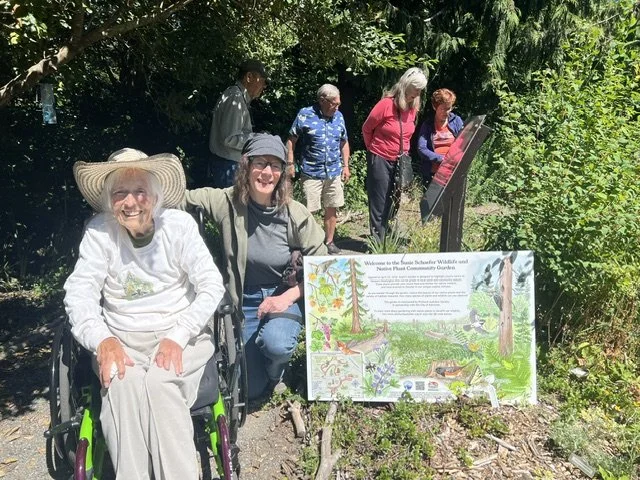
Susie seeing her garden’s new sign. July 10, 2026
In Memory of Susie Schaefer
by Laura D. Walls, co-coordinator of the Susie Schaefer Wildlife and Native Plant Community Garden / July 29, 2026
We are saddened to learn of the passing of Susie Schaefer, on Saturday, July 25. Susie was the founder of Edmonds’ unique native plant garden, which the City of Edmonds recently renamed the Susie Schaefer Wildlife and Native Plant Community Garden in her honor. Susie founded the garden in 2009, when she shared her vision for turning a small corner of abandoned land into certified National Wildlife Federation habitat with a group of local volunteers, who helped her bring it into being. Vision became reality when the Edmonds Wildlife Habitat and Native Plant Demonstration Garden opened in April 2010.
In 2025, when the new name for Susie’s Garden became official, the Pilchuck Audubon Society—now the garden’s official sponsor—commissioned a new sign featuring artwork by local bird artist Laurel Mundy. On Friday, July 10, Edmonds City Park staff members brought the new sign to the garden for Susie to see. The instant she saw the sign, her huge smile lit up the entire garden! Susie kept smiling for the next 90 minutes, while she toured the garden and visited with friends. It would be the last time Susie saw the beautiful place she brought into being and cared for with such passion for so many years.
Susie joined the Pilchuck Audubon Society in the late 1970s, after moving from California to Edmonds. She was a social worker who worked with the elderly and disabled, and thanks to her love for birds, animals, and the Edmonds community, she became a forceful advocate for local environmental causes as well. Her garden, which began with just a few native plants, soon grew into an educational center, as Susie organized programs on pollinators, frogs, native flora and related subjects. It continues to be the site of various programs and events. Visitors are welcome to come anytime and wander its trails, which lead to the grounds of the Willow Creek Fish Hatchery and the forested edges of the Edmonds Marsh-Estuary. Identification signs help visitors see how our native plants thrive despite our wet winters and warm, dry summers, while sheltering and nourishing generations of native birds and wildlife.
The new sign is now installed in a temporary location overlooking the garden’s parking turnout. It will be installed permanently sometime after August 15. Once installation is complete, there will be a dedication ceremony and celebration of Susie’s life. Details will be announced, including in this newsletter, as soon as they become available.
The Susie Schaefer Wildlife and Native Plant Community Garden, located at 95 Pine Street just off Highway 104 in Edmonds, Washington, is open 365 days a year. Visitors are always welcome. Parking is available on a small turnout by the upper garden, and along both sides of Pine Street.
It was Susie’s wish to not have a funeral, but instead a moment of silence will be held for her Saturday, 8 August at 11:00 AM PST at Lake Kirkwood in California.
We encourage you to join us at that time wherever you are for a moment of silence to recognize a truly wonderful and amazing woman who personally helped countless individuals with disabilities, animals all over the world, and stood as a steadfast person of action for the environment, human rights, dignity, and peace. Please feel free to help us celebrate Susie.
Bird Walks in Redmond and Kirkland, July 4, 2026
By Douglas Resnick
We began the morning at Sixty Acres Park in Redmond. The air was slightly cool, and the sky was cloudy, but there was no rain. The planned birding would start on a nearby trail, but we listed our observations at the meeting place, while waiting for the last of our crew to arrive. We found several American Robins on the adjacent athletic field, and a couple of Cedar Waxwings. More numerous were the American Crows, perhaps trailing members of the morning's dispersal from the new Eastside crow roost.
Together, we walked out of the parking lot, up the ramp towards NE 116th St., westward over the river, then down the ramp to the West Sammamish River Trail. From the trail, we could see and hear birds in the river, along its banks, in the air above it, in or on the trees and shrubs on either side of the trail, and occasionally on the trail itself. Most of the birds in the river were Mallards. They were joined by a couple of Great Blue Herons. One Wood Duck flew over the river, as did one Belted Kingfisher and two Violet-green Swallows. We heard several birds that we could not see, including Western Warbling Vireo and Swainson's Thrush, but there were more that we heard first, then found by sight. The most welcome of the latter were two Purple Finches, which usually sing from hidden perches, but which came out into the open on this occasion. We were also able, by prolonged searching, to gain views of two Willow Flycatchers, a Common Yellowthroat, and several American Goldfinches. We walked as far as the trail's intersection with the PSE Trail, where we paused briefly to enjoy the view from the bridge that spans the river, and then we returned to our cars.
Next, we drove to Juanita Bay Park in Kirkland. Setting out on the park's eastern trail, we gained the day's first view of an Osprey, which stood atop a snag while eating a fish. On another snag, we spotted a Northern Flicker. Once we got past the vegetation along the trail's west side, we could observe the birds nearby in the bay, a mixture of Canada Geese, Wood Ducks, Gadwalls, and Mallards. After retracing our steps, we visited the three viewpoints south of the bay. From these, we were able to see yet more of those ducks. Some aggressive behavior caught our attention: one Wood Duck displaced a Gadwall from a log floating in the water, and two Mallards fought one another, to no obvious end. We also saw an Osprey being harassed by a Bald Eagle: the Osprey dropped its fish, but immediately dove after and recovered it. Was this the same Osprey that we had seen earlier? In the end, we saw two Ospreys, side by side, on a platform mounted on a post sticking far out of the water. Our most exciting find, however, was a pair of Virginia Rails, one adult and one juvenile, which made repeated calls while the pair foraged in the shallows beside the walkway leading to the final viewpoint. We ended our outing, somewhat late, having reported observations of 41 species. Several of us celebrated with lunch at Pizzaiolo Wood Fired Pizza.
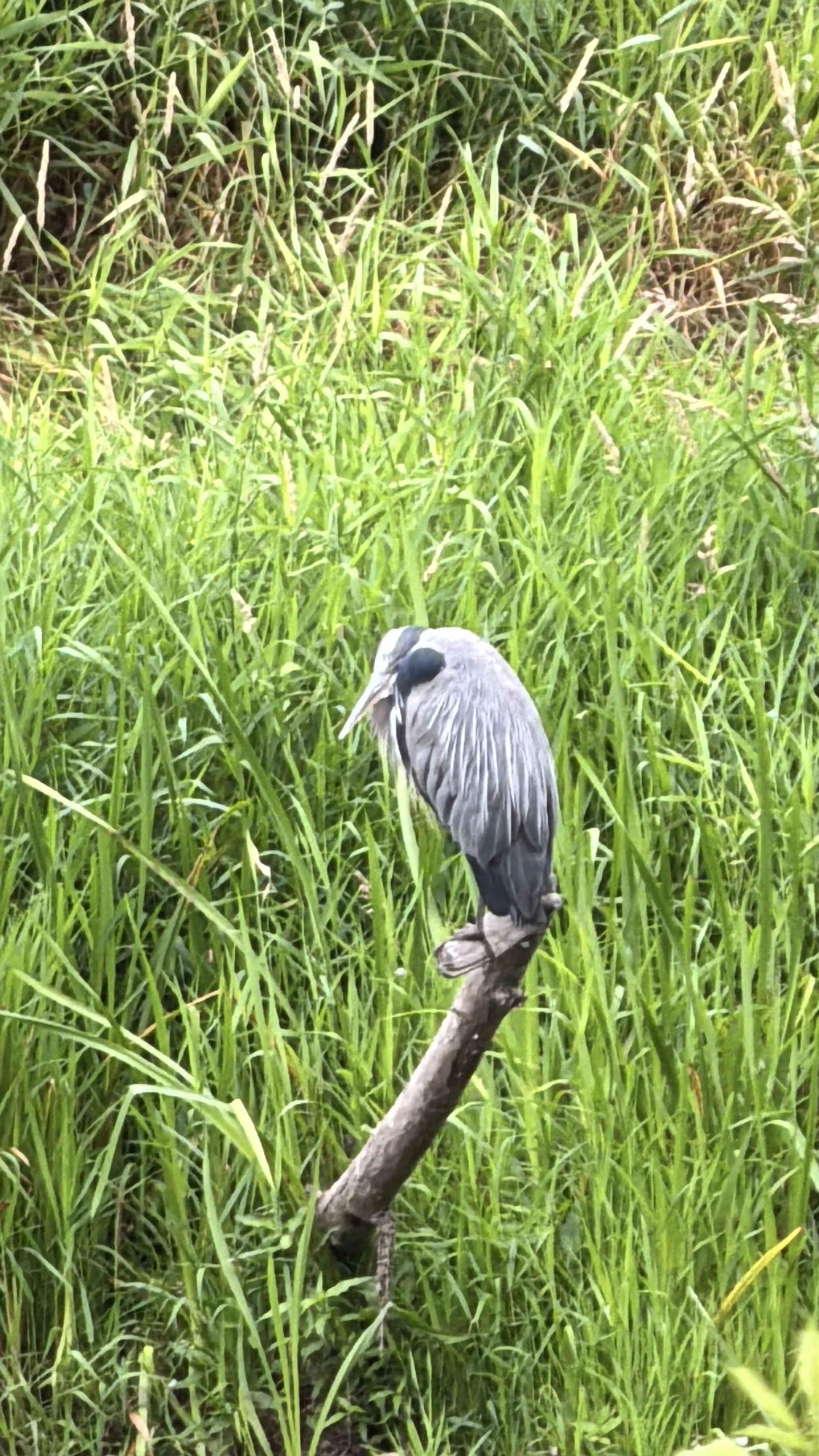
Great Blue Heron by Lisa Weber
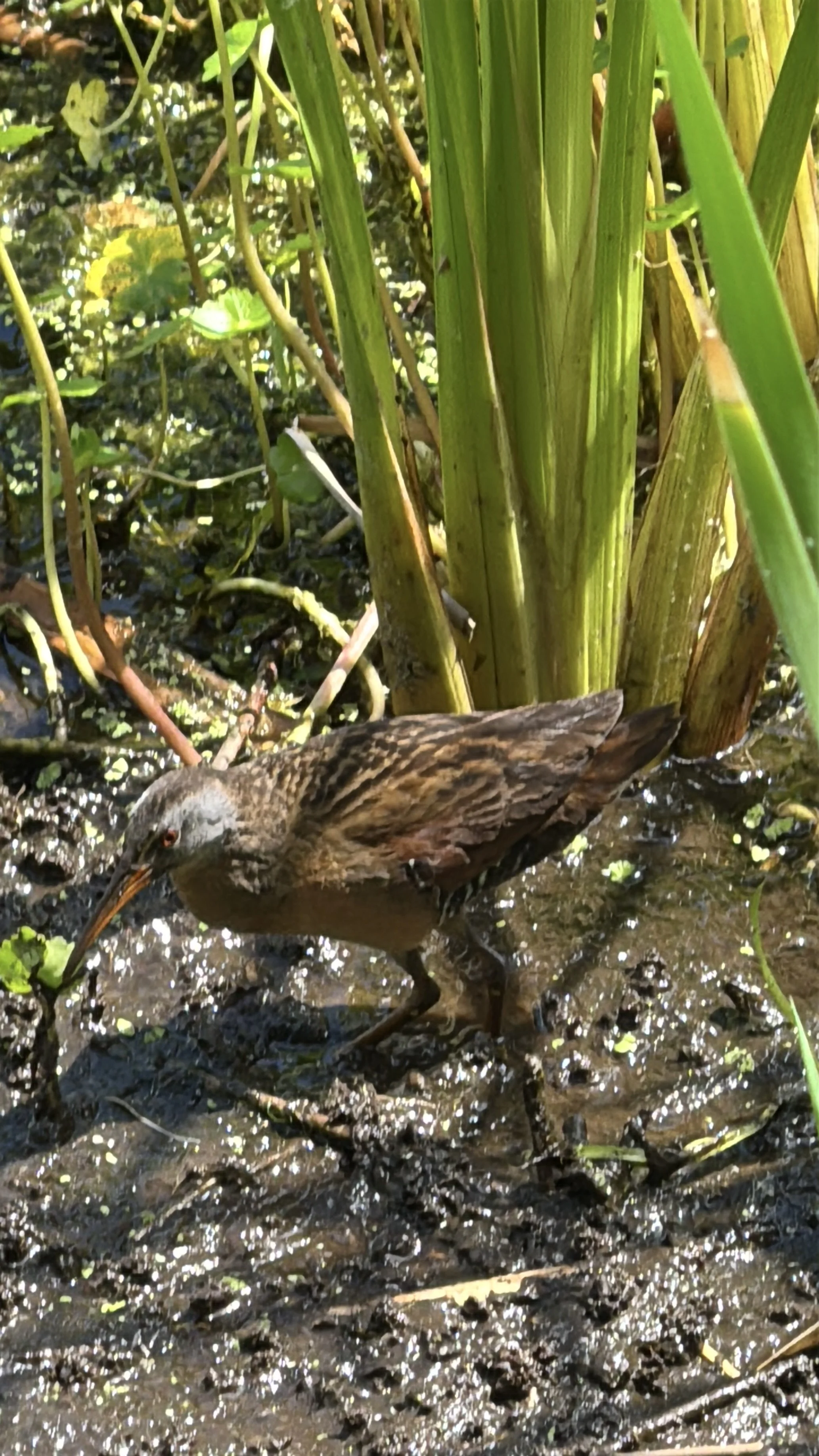
Virginia Rail by Lisa Weber